Free but ticketed to allow the organisers ‘to keep numbers at a safe and comfortable level’, one could be forgiven for thinking they had accidentally stumbled into bookings for Rio 2016, but this is a selection of ten of Leonardo da Vinci drawings, on tour from the Royal Collection to galleries across the UK, and for the first time, the National Gallery, Ireland.
The ten drawings have been selected from the 600-odd in the Collection to reflect the diversity of Leonardo’s interests, including painting and sculpture, but also engineering, anatomy, cartography, geology, and botany. Studies for casting an equestrian monument; and Further casting studies, and lines of poetry present Leonardo’s detailed and carefully annotated engineering solutions to the problem of casting, in a pre-machine age, a seven-meter high bronze horse. Studies of an infant’s limbs reflects the Renaissance’s interest in life drawing, and its preferance for chubby-to-the-point-of-obese Christ-Childs.
The heart compared to a seed and The vessels of the liver, spleen and kidneys fill two sides of the same sheet of paper. These are the notes and drawings he made following his dissection of the corpse of a 100-year old man (one of 30 dissections he performed), ‘to see the cause of so sweet a death’. He resolves a medical connundrum in the former drawing as to which organ was the more vital, heart or liver. It is bitter-sweet to learn that most of his findings remained unknown to his contemporaries and successors. The beautifully produced and highly informative catalogue tells us that his notebooks were not published until the late 19th Century, and much research on them has been done only in the last few decades.
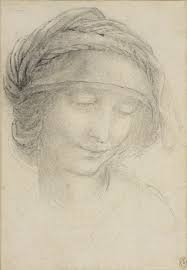 The Madonna and Child with St Anne occupied Leonardo intermittently for a remarkable two decades, and A study for the head of St Anne is probably the best known of the drawings on display. It is unexpectedly small (18.8x13cm), drawn in ‘black chalk, wetted in places’, on the rag-pulp paper which gives it the strength and stability credited with keeping the drawings so wonderfully preserved. St Anne’s face emits a radiance that feels impossible for a 550 year old artefact, and one so humble as a study.
A personal favourite is Blackberry and bird’s-foot trefoil, drawn in red chalk on orange-red prepared paper, which forefronts a simple sprig of briar weighed down with its berry clusters. It’s nice to think that Leonardo probably popped one of those berries into his mouth when he had finished drawing, and that it would have tasted the same to him as it does to us today.
Leonardo da Vinci saw connections between seeming disconnected areas, and his learning in one field inspired his exploration of another; the process and discoveries were of as much interest to him as the finished product, which sometimes resulted in less than comfortable living circumstances. It is extraordinary to contemplate the extent of his creativity, and above all, this exhibition serves to illustrate his openness and curiosity, about everything.
Despite the twenty-minute timed slots and a midweek, midmorning visit, the two viewing rooms were uncomfortably busy, begging the question of why we crowd to see famous artworks. John Berger, in his seminal Ways of Seeing (1972), says rather bleakly that ‘the uniqueness of the original now lies in it being the original of a reproduction’. In other words, because it is famous, we can see Leonardo’s Head of St Anne on mugs, tea-towels, magnets, or nowadays, online, but we still want to belong to that collective who can claim to have seen the famous original.
No doubt there is an element of truth to this. But there are other reasons to visit exhibitions like this one, even if it does mean some conspicuous hovering and occasional sighing from those impatient for their turn. When we encounter a picture which reaches across five and a half centuries, an untranslatable exchange occurs between the viewer and the work of art. Time can seem both to fall away and to compress, and we are confronted with the Rennaissance in a real and visceral way that no academic description, or no fridge-magnet reproduction, can recreate.
Until July 17th.

