Gods & Angels by David Park (Bloomsbury UK, 2016)
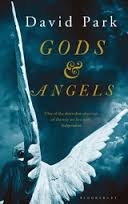
The gold curlicued lettering and blue-black gothic-inspired cover of Gods & Angels seems better suited to a YA apocalyptic fantasy, and it gives no hint that this is a book of short stories. But these are minor quibbles when the writer is David Park, whose nine previous books include IMPAC-shortlisted The Light of Amsterdam, The Truth Commissioner, and The Poets’ Wives.
Gods & Angels takes its title from Hamlet’s ‘What a piece of work is man’ speech, and it aptly encompasses the book’s dominant theme of masculinity. In ‘The Bloggers’, the separated husband protagonist — there are several – dedicates his new blog, Spartacus, to “men’s issues”, gently mocking them. The issues are varied, but fear, inadequacy, and isolation hover just beneath the surface for most of the predominately male protagonists.
In the opening story, a lecturer learning to swim also learns to navigate a relationship with a very different social group of men. He worries that his lack of football knowledge, or his English accent, or his soft hands will diminish him in their eyes. In ‘Gecko’, a teacher nearing retirement travels to see the Northern Lights with his wife for their 25th anniversary, but the experience is marred by his secret failing. In ‘Skype’, a man lives out his retirement on the island he moved to as part of a young couple, limited by his dual identities of retired master, and deserted husband. In ‘The Painted Cave’, a small-time hustler hides in a cave from his pursuers until, aided by the ancient cave paintings, he hallucinates away the murder of the girlfriend he abandoned to her fate.
One of the most affecting stories, ‘Man Overboard’, follows a group of men who have reluctantly included their depressed friend on their weekend away. They struggle to express emotions, and the narrator notices that they always revert to stories from their shared past, rather than discuss their current lives. Yet somehow, when their friend breaks down, they find a way to reach him. They may not have the words they think they should, but in the hands of Park, this can be ok too.
Short story collections inevitably invite comparisons between stories, and the least successful here is ‘The Strong, Silent Type’, whose protagonist is a shop mannequin borrowed by a teenage girl to make a statement at her school ball. It is commendable that Park is prepared to step outside his usual realism, but the narrative voice never quite stabilises, and the mannequin feels gimicky, a vehicle on which to hang man-talk and comments about “real men”, and does not convince.
Park successfully transends the real, however, in the incredibly moving final story, ‘Crossing the River’, which is dedicated to the memory of his mother, Isabel Park. The narrator is a licenced ferryman who transports the dead from one world to the other. But he is also the author of this and other stories in which he transports his characters from starting point to denouement. He wants to tell one frightened young woman that he knows the currents, that he’s never yet lost a passenger. But his professionalism comes as close as it ever has to compromise when he has to transport his own mother — Park’s own mother — from this life, which was taken gradually by dementia, to the next. This is as good a short story as you will read anywhere.
Park is a consummate stylist, and Gods & Angels flows and startles by turn, its language ever attuned to the requirements of the given moment. Sometimes these moments can seem hopeless, but for all the failings of its protagonists, the stories in this collection ultimately offer plenty of reasons for optimism.

