I was sad to hear of the death of Umberto Eco, and though, at 84 years of age it should not have come as a surprise, it did. He was a giant of a novelist, and as such seemed immortal. (He was also an academic —semiotician and philosopher — but I did not know him in these capacities.) I was one of many who threw myself into the middle ages world of the Rosicrucians in In the Name of the Rose; I loved every second, then I loved it all over again when Sean Connery did the honours as Brother William in the 1986 movie. But it was Foucault’s Pendulum (1989) that sucked me in and swallowed me whole. I groped around in that tome for what felt like forever – in a good way. I didn’t want it to end, nor did it bother me unduly that half the time I didn’t know what was going on.
I’ve made a few trips to Bologna over the years. Somewhere in the mid-nineties I was there at the same time as the great man himself (he was Chair of Corso di Laurea in Scienze della Comunicazione, University of Bologna from 1993-1998). A conversation with a student who claimed to know him found me zooming through the medieval streets on the back of a strange boy’s Vespa and up into the surrounding hills where an open-air party was in full swing: music, beer, beautiful Italians, moonlight, etc. etc. — but it soon became apparent that my escort wanted one thing whereas I only wanted to meet Eco. He took me mutely back to the city and to the bar Eco was known to frequent, but alas, this was not one of his nights. He would be in the following evening, the barman said and my companion translated. But I was flying home the next day. I wildly considered trying to change my ticket, but reason prevailed, and I settled for reading his books. RIP, Umberto Eco.
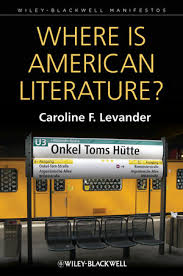 Where Is American Literature? is a thought-provoking approach to the creation of canons, where one might find American literature, and even if such a category can be so easily defined. There’s lots of juicy stuff, about book clubs and high versus middlebrow art (who doesn’t love to remember the Oprah/Franzen tussle), and the history of reading in the US military, and much else. Levander challenges any preconceived idea we might have of what American literature is, and she looks for it instead in unlikely and liminal spaces.