Sun, Sea… And Kids Home From School

It’s that time of year. Sun, sea, and kids home from school all day long.

I was at an event recently featuring two male writers and one female, and I wondered how long the female writer would be able to hold her tongue while one of the male writers explained how he filled his daily eight hours’ writing time. She looked as if she was trying not to bite it off! As sun, sea and kids threaten to completely engulf my writing time, I wonder how many female writers have ever struggled with the problem of filling eight hours’ writing time…

But let’s not stoop to bitterness. It’s an easily surmountable problem if, like me, you planned your family carefully (ahem…). For forty-five minutes each the two older kids occupy the twin four-year-olds and I have one and a half hours to write. It’s not eight. But reader, here’s the thing: the tighter my time, the more productive I become. In three of the above sessions (plus a bit of less precious, much-interrupted time) I outlined a story and put down 7000 words. If there’s a moral to be had, I suppose it’s not to make excuses. And maybe to trust in the revision process… that will wait for September.

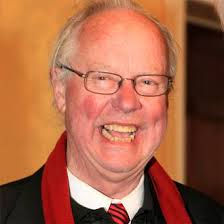
Meeting Brendan Kennelly

Yesterday, I bumped into the poet, Brendan Kennelly, who was also one of my old college teachers; a little bit of synchronicity since only the day before I was remembering (ably assisted by google. Is there a hybrid word for that kind of remembering?) one of his poems, I See You Dancing Father.

Over latter years I’ve passed him often in my to-ings and fro-ings through Trinity College and he never fails to greet me with his famous smile, even though I am one of thousands of his past students. I was lucky enough to participate in one of his creative writing classes – rare as hen’s teeth in those days – but, alas, they were completely wasted on me. As much as I wanted it, whatever ‘it’ was, the penny hadn’t yet dropped. I had nothing to say, or I was trying to write poetry when I should have been trying to write prose, or… something.

But all was not lost because, unbeknownst to me at the time, it was in his Irish Poetry lectures that I learned to tune my ear to the music of language. Through the recitations which I remember as making up a good part of the lectures, I began to understand the importance of sound, the rhythm and balance of sentences. What I did know then was that I could have listened to Brendan reading his poems with his Kerry accent forever. Have a listen and hear for yourself.

I’m not sure why I didn’t tell him any of this when we met. Maybe I only figured it out after we parted. Instead we talked about my novel. Now, as anyone out there who writes knows, though folks may ask about your work-in-progress, may believe themselves to be genuinely interested, as soon as you begin to explain their minds begin to drift. You can see it in their eyes, a sort of deadening. Not so Brendan Kennelly. His listening was as lively as his talk, and he made spot on observations and comments.

He had plenty to say himself too. We talked about operations and childbirth and surgeons made of rain, missing letters and reviews, ‘Seamus’ (Heaney), early collections, early rising. A recitation especially for me, an audience of one. When I asked what he was working on he said he was ‘scribbling away’.

It was an honour and a privilege to sit and chat with him, and it made my day.

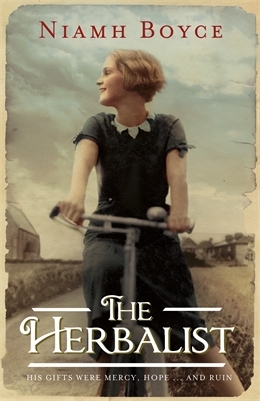
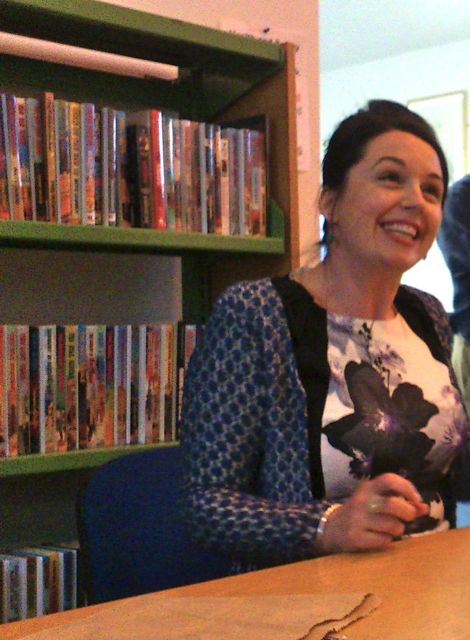
Launch of The Herbalist by Niamh Boyce

I was in my home town of Athy, Co. Kildare on Tuesday night, and spent a very enjoyable hour or so at the launch of Niamh Boyce’s The Herbalist, which happens to take place in a fictional town very like Athy. Set in the ‘thirties, it tells the story of a stranger to the town who sets out his market stall, trading in herbs and creams, and darker arts. The novel is based on a newspaper clipping Niamh came across about a man who was charged in court with ‘an offence against a girl.’

The library was packed, the wine flowing, and the woman of the moment, well… busy, trying to keep up with the long queue of folks wanting their book signed, the lucky ones who managed to buy their book before it sold out. Patricia Deevy, of Penguin Ireland, and writer, John McKenna, gave rave introductions to both author and book. Deservedly. I started reading the next day, and neglected home and children (and writing…) until I finished it this morning. It’s a wonderful read; there’s a beautifully light touch to the prose, a steadily growing darkness in the plot, and characters who I suspect will remain with me long after reading.

Before we left, the evening took on a slightly surreal quality when a local grocer and publican, now I believe in his nineties, leaned over and told my mother and me (of the herbalist) ‘I remember him well.’

Making Time For Proust

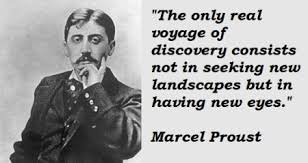
This is my summer of Proust. Long overdue, 100 years to be precise, In Search of Lost Time has been on my ‘must read’ list forever. I have not approached a book with such apprehension since Ulysses when I was 18. And now that I’ve started the first volume, By The Way of Swann’s, it’s still taking me forever. Not in a bad way. It’s just that every few pages, sometimes every few lines, something in Proust’s meandering reverie triggers one of my own and I find myself staring off into space, my mind gone somewhere else, which of course means having to reread in order to find my place when I come back to the book again. A part of me, the one-time lit crit student, perhaps, is telling me I should be making steady, diligent progress; there are seven volumes, after all… But I’ve decided to listen to the other part, the writer-part, and it’s telling me to follow Proust’s lead, to take the slower, more scenic route in order to better savour the language and images, and to allow for diversions along the way. The summer of Proust has become the summer of making time for Proust.

So, I’ve reached the end of part one. Anyone who writes will recognise the moment the desire to write and the inspiration come together in the form of words for the first time, but few have expressed it as eloquently as Proust does here. The young Proust is sure that he wants to be a writer one day, but worried that he may not find a philosophical subject on which to write. Then, while taking a lift in Doctor Percepied’s carriage something shifts:

‘At the bend of a road I suddenly experienced that special pleasure which was unlike any other, when I saw the two steeples of Martinville, shining in the setting sun and appearing to change position with the motion of our carriage and the windings of the road…
As I observed, as I noted the shape of their spires, the shifting of their lines, the sunlight on their surfaces, I felt that I was not reaching the full depth of my impression, that something was behind that motion, that brightness, something which they seemed at once to contain and conceal.’

The carriage sets off again after a short stop and:

‘I was obliged…to fall back on my own and try to recall my steeples. Soon their lines and their sunlit surfaces split apart, as if they were a sort of bark, a little of what was hidden from me inside them appeared to me, I had a thought which had not existed a moment before, which took shape in words in my head, and the pleasure I had just recently experienced at the sight of them was so increased by this that, seized by a sort of drunkenness, I could no longer think of anything else.’

He writes the words down on a scrap of paper.
‘…I was so happy, I felt it had so perfectly relieved me of those steeples and what they had been hiding behind them…’

I think this is what many of us mean when we say it’s not that we like writing, rather, we like having written.

As it turns out, I’m not alone in coming late to Proust. Someone suggested thinking about the seven volumes as just another Harry Potter; that gives me about 10 years then, so no rush! My apprehension has been steadily lessening since I started reading, and it’s been interesting and a help to read the thoughts of others embarking on the same project:
Surrender to Proust
Amateur Proust

Operating On The Fumes Of Mystery: A Masterclass With Colum McCann

 Let The Great World Spin is one of my favourite books of the last five years, and it had a big influence on the structure of my recently finished novel,
Michaelangelos, as well as on my current work-in-progress. Thanks to the Dublin Writers’ Festival and their tweeted offer of a free masterclass with none other than Colum McCann, I found myself yesterday in the Irish Writers’ Centre, along with about 20 other speedy tweeters, pen poised, waiting to learn how it’s done. For those who didn’t get in (the places were gone in a matter of minutes) here’s my attempt to pass on the gems garnered.

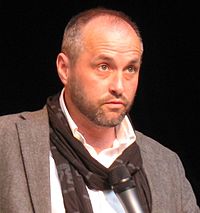
At the suggestion of Liam Browne, the festival Director, discussions began with the question of structure. Colum, by the way, looks exactly like his picture, and was warm, affable, approachable and generous. He started with a quote from writer, John Berger:

‘Never again will a single story be told as though it’s the only one,’

meaning, that events are seen through the eyes of many, perspectives which interconnect and touch one another. He told us that he had wanted to write a book about Philippe Petit and his tightrope walk between the twin towers, but in the end it was the people on the ground who were more interesting to him. He made a later point that a good narrative perspective for a writer to adopt is that of the privileged view of the outsider, like Nick Carraway in The Great Gatsby.

Colum emphasised the importance of reading as much as possible, observing that we get our voice from the voices of others. Our reading lists were expanded, with recommendations to read Aleksander Hemon, whom he describes as one of the (or possibly ‘the’ – why I’m not a journalist) greatest writer today. He also mentioned Tea Obreht (The Tiger’s Wife is in the tbr pile already), Louise Erdrich, Rachel Kushner, and Ann Patchett.

This question of voice was addressed from an unusual angle. Contrary to the old chestnut ‘write what you know’ Colum advised writing what you don’t know. He suggested that we write towards what we want to know instead, and that this facilitates a leap of the imagination to an unconstricted place of freedom. In pursuit of multi-threaded narratives we write away from ourselves, into the unknown. We are operating on the fumes of mystery. We would, he added, find ourselves writing towards our obsessions anyway.

On characterisation, he said we should know all the details of our characters, biography, preferences, etc., but focus on an extremity of detail, something that makes the character unique in the world. Only when we have created the characters should we do the research, and it is in this research period that we look for a language, or a voice, for our character. This brought us back to ‘write what you know,’ in the sense that we only have at our disposal words and skills that we know.

Colum described failure as vivifying, and said that the ability to fail was an important trait in a writer since it’s what we do every day – fail to put on paper what we have in our heads. Other important characteristics were desire to write, stamina, and perseverance. Here, he quoted his colleague Hemon, who says ‘it’s all shit, until it isn’t.’

Like the good teacher he is (McCann teaches at Hunter College, New York) no one in the group was left with a question unanswered. Everyone there was clearly passionate about writing, and the questions were wide-ranging. Miscellaneous answers informed us:

  • That Colum is not in favour of timelines or maps or excessive planning. In his view, the plot is the least important aspect, and that it emerges through language, and through character, and through honesty. Maps, he felt, took away the adventure, took away our space to experiment, our space to fail.
  • That Fup, by Jim Dodge is a good book for teenagers, or anyone, to read.  
  • That he’s in favour, as am I, of the em dash (in place of inverted commas to denote speech), especially for literary fiction.
  • That his favourite writer (and one of mine – we have so much in common!) is Michael Ondaatje.
  • That feeling a fraud and a charlatan, and that you’ll never be able to do it again after finishing writing a novel is normal. 
  • That reading your work aloud is a good idea, because you better see patterns, repeated words, awkwardness. He even goes so far as to get his work read to him by people who speak as his characters might.

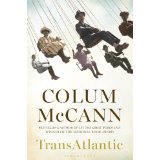
All in all, Colum was very inspiring, encouraging, and informative. And in favour of editing out all excess words… So, if you’ll excuse me, I have not yet broken the spine of TransAtlantic.

Ballymun Booker

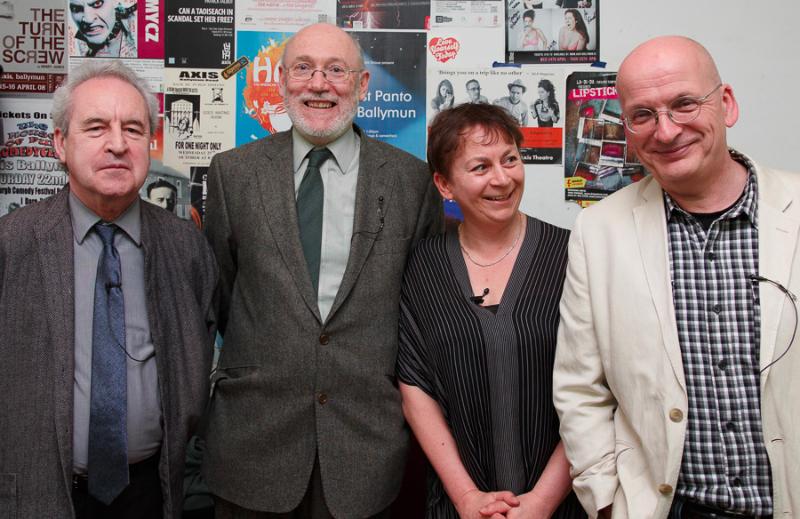
The only Irish Booker prizewinner missing at Axis Ballymun was Iris Murdoch. This illustrious event with John Banville, Anne Enright, and Roddy Doyle was a lot of fun last night. Three readings were followed with lively discussion, all ably directed by Dermot Bolger. It nearly ended on a bum note though. An audience member asked what someone should do if they have been writing a lot, for a long time, and getting nowhere, to which John Banville replied, ‘do something else.’ But this was amended by a suggestion from Anne Enright to write less and to do more rewriting, and by Roddy Doyle to look at putting work online and getting feedback that way. John Banville added that his answer came from something he had said about himself, that he wished he had ‘lived more and written less.’

Reading In Translation: Re-receiving Language

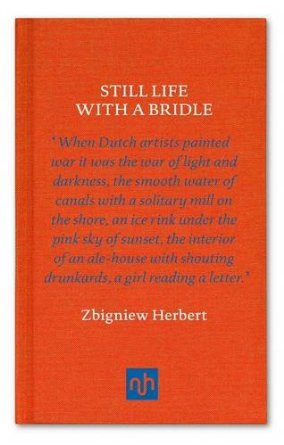
This small, cloth-bound, vivid orange book is a book of essays on 17th century Dutch Art, called Still Life With A Bridle, by Zbigniew Herbert, a Polish poet I heard of only recently. No, wait – don’t stop reading! My favourite novel for a long time was The Baron in the Trees by Italo Calvino. Recent books I have enjoyed and considered noteworthy include: Gerbrand Bakker’s The Twin, Herman Koch The Dinner, and W. G. Sebald’s The Emigrants. Other infatuations include Umberto Eco, Haruki Murakami, Flaubert, Barthes, Gabriel Garcia Marquez, Miguel de Cervantes, and Chekhov. My tbr pile is topped wiht the first volume of Proust’s In Search Of Lost Time. 
I read books in translation for all the reasons I read books written in English – pleasure, escapism, insight into the whys and wherefores of life. I also read them to learn about other cultures, and the diversity of possible experiences and ways of thinking: the same reasons I like to travel. Colombian mysticism and magical realism, Italian fantasy, Russion angst, seventeenth century Spanish humour – these are some of the things I’m after. It’s the next best thing to actually travelling. I also read them to enrich actual experiences of travelling. Like travel, I like to think that reading books in translation expands my mind.
When I was an undergraduate student, one of my favourite academic occupations was ‘translating’ Beowulf. I use parentheses because, as poor Mr. Pfeiffer would attest, I was not the world’s most gifted student of Anglo-Saxon. Yet, because I loved the poem I read and re-read many different versions, and because the similarities to modern English are plentiful enough, the writer in me enjoyed puzzling together pieces of different jigsaw puzzles to make a new whole. [All this before Seamus Heaney’s beautiful translation. Just as well; after Heaney, I may not have bothered.]
Like most writers, I read as much and as widely as I can, and I only lately noticed that among the five or six books I usually have on the go, there is at least one in translation. Though I write mostly fiction, and read lots of it, I also read essays and poetry because language is used differently there, I believe. And if these happen to be in translation too I have to work even harder and pay better attention to the words, the sentences, the maybe unfamiliar imagery/metaphors/ references. This is why the books in translation are often the ones I read most slowly, to better savour small chunks or phrases, even just a word. 
‘light like honey’, 
‘monotonous’, 
‘eerie’ 
‘A modest, laborious, worry-filled grey life.’
These are in my current read, but used in slightly unusual contexts. Sometimes words selected by translators are closer to the word in the original language than the one we might more commonly choose in English. Or sometimes the construction of the sentence, the phrasing, owes more to the original language. The effect in a good translation is to make language fresh and alive, to give words back their meaning which may have grown faded through overuse or just through common use. Reading in translation feels like a re-receiving of language, making it new again.

High Tide

The inlet at Sunnycove, Leap, so beautiful Ophelia herself could have lain here, provides the setting for my short story High Tide. I’m thrilled to have been shortlisted in RTE Arena New Planet Cabaret  competition, not just because of the honour in being selected, and the fine company I’m in, but because this time… it’s personal! All fiction is largely autobiographical, someone said. I don’t know if I agree, but in this case, it’s true: High Tide is based on my great-grandmother, Ellen O’Donovan, and set in her house and garden, Sunnycove. I wonder if she’d approve…