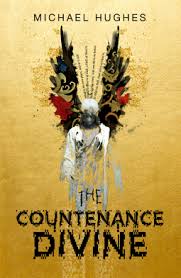
Note: the author and I share a publisher and an editor, so I was always going to be well-disposed towards this novel; the gorgeous gold cover helps too. Note two: I acquired a proof completely accidentally, and no one has asked me to review it; I wanted to because I enjoyed it so much.
The Countenance Divine opens with Chris, a computer programmer who is working to fix the Millennium Bug. The prose in this section is somewhat monotonous, corresponding to Chris’s nerdy character, but the unfolding story is intriguing. In Chapter Two, we meet another narrator, who writes letters of murders and dismemberment ‘from hell’ in an entirely different register. Wisely, his grisly, phonetically-spelt contributions are kept brief, and we are soon on to the next narrator, William Blake, who is in some sort of communication with John Milton. Finally, we meet an acquaintance of Milton himself.
Hughes is completely in charge of voice, his other occupation of actor perhaps giving him an edge in this department. The plot moves back and forth between 1999, 1888, 1777, and 1666, and the reader is whisked along, aided by formatting signposts such as ‘from hell’, or numbered sections, or simply by stating the year, so that it is never confusing. This weaving of voices and time-periods has echoes of David Mitchell’s Cloud Atlas, and there is also a touch of Harry Potter’s fantastic struggle between good and evil, but strictly for grown-ups who like poetry, and don’t mind disembowelments.

