What is modernism? When did it began? When did it end? Who were its key figures? These are hotly debated issues. Who were the the women involved in modernism in Ireland? Not so hotly debated, perhaps. I could probably have named Eileen Gray and one or two others at most. This is why the exchange of ideas on the subject, organised by Dr Roisis Kennedy (UCD) and Dr Aintzane Legarreta (IMMA), seemed like it could be a morning well spent.
Sabina MacMahon was first up, and a highlight for me. She’s an artist interested in speculative history, and she talked about the little known An Ulaid – South Down Society of Modern Art. We saw slides of photographs of the founding members, and samples of their work. MacMahon bemoaned the lack of archival material for her subjects, but conceded that this was because she had made them, and the entire movement, up. The photos were of her grandmothers and their friends; the paintings were her own. It was the art equivalent of Stephen Marche’s Shining at the Bottom of the Sea (a made up island and people, and their entire culture). Her talk earned plenty of laughs, but made a serious point.
Dr Elaine Sisson gave a lively talk on “Toto” Cogley’s Cabaret Club. Led by Madame Bannard “Toto” Cogley, who was one of the founding directors of the Gate theatre, this group boasted up to 400 member. Yet almost no archival material exists. There was a suggestion, following on from Sabina’s earlier talk, that we should just make our own.
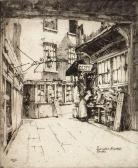
Dr Angela Mary Griffith, from Trinity, talked about Myra K. Hughes’s etchings. I knew nothing about either Myra K Hughes, or etching, so it was enlightening. Her use of empty space was interesting to me in relation to my own novel, Generation, which tells a story from multiple points of view over multiple decades, leaving plenty of empty spaces for the reader to fill in. For my daughter, currently torn between subject choices of art and metalwork, maybe it’s not such a conflict after all.
Professor Anne Fogarty, from UCD School of English, (and patient supervisor of my many moons ago thesis on Edna O’Brien’s Night), has been researching newspaper records of the Women Writers’ Club, which existed from 1933 – 1958. She noted that while scholarship has long sought to establish a panel of important Irish women writers, such a record already existed in the form of the Club’s list of Guests of Honour: Blanaid Salkeld, Nora Connolly O’Brien, Christine Longford, Helen Waddell, Edna Fitzhenry,Dorothy Macardle, Elizabeth Bowen, Temple Lane, Patricia Lynch, B.G. McCarthy, Kate O’Brien, Ethel Mannin, Teresa Deevy, and Enid Dargan.
ADDENDUM: An Irish Literary Set that was more Bloomsbury than Barstool
Unfortunately I had to skip out early to pick up children – plus ca change – and missed the last talk and closing remarks.

